Safety Rules
Bicyclist safety
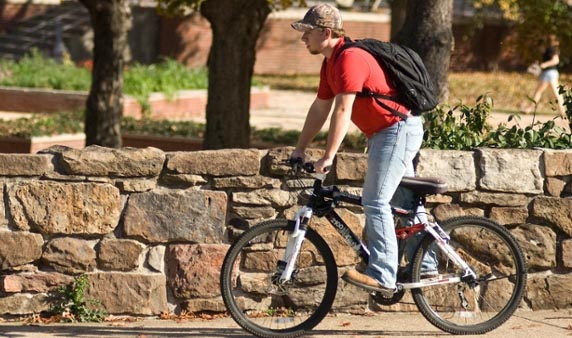
Every person operating a bicycle on university property shall do so in obedience to all traffic control devices, the “Illinois Bicycle Rules of the Road,” and the regulations included herein.
Persons riding bicycles on campus shall practice courteous, defensive riding, giving due consideration both for pedestrians and for conditions that require traveling at safe speeds and having their bicycles under control at all times.
In accordance with the “Illinois Bicycle Rules of the Road,” every bicycle, when ridden during the period from sunset to sunrise, shall be equipped with, and have operating, a front white lamp and a rear red reflector or lamp. In addition, every bicycle purchased new after July 1, 1973, must be equipped with additional safety devices, including:
On each pedal, a reflector can be seen from the front and the rear of the bicycle for a distance of 200 feet after dark.
Side reflectors, front and rear, are visible at night in reflected light for a distance of 500 feet. The reflector to the rear of the center of the bicycle must be red; the reflector to the front of the center must be amber or yellow.
No person shall operate on campus a bicycle that is in such an unsafe condition as to endanger any person or property, or that is not equipped as required by the Illinois Vehicle Code.
Ride Resonsibly
- Ride your bike responsibly. All states require bicyclists on the roadway to follow the same rules and responsibilities as motorists
- There are two main types of crashes: the most common (falls) and the most serious (the ones with cars). Regardless of the reason for the crash, prevention is the name of the game; there are things you can do to decrease your risk of a crash.
Be prepared before heading out
- Ride a bike that fits you—if it's too big, it's harder to control the bike
- Ride a bike that works—it really doesn't matter how well you ride if the brakes don't work.
- Wear equipment to protect you and make you more visible to others, like a bike helmet, bright clothing (during the day), reflective gear, and a white front light and red rear light, and reflectors on your bike (at night, or when visibility is poor).
- Ride one per seat, with both hands on the handlebars, unless signaling a turn.
- Carry all items in a backpack or strapped to the back of the bike.
- Tuck and tie your shoelaces and pant legs so they don’t get caught in your bike chain.
- Plan your route—if riding as a vehicle on the road, choose routes with less traffic and slower speeds. Your safest route may be away from traffic altogether, in a bike lane, or on a bike path.
Ride defensively-Focused and alert
- Be focused and alert to the road and all traffic around you; anticipate what others may do before they do it. This is defensive driving—the quicker you notice a potential conflict, the quicker you can act to avoid a potential crash:
- Ride with the flow, in the same direction as traffic.
- Obey street signs, signals, and road markings, just like a car.
- Assume the other person doesn't see you; look ahead for hazards or situations to avoid that may cause you to fall, like toys, pebbles, potholes, grates, and train tracks.
- No texting, listening to music, or using anything that distracts you by taking your eyes and ears or mind off the road and traffic.
Ride predictably
- By riding predictably, motorists get a sense of what they intend to do and can react to avoid a crash.
- Drive where you are expected to be seen, travel in the same direction as traffic and signal, and look over your shoulder before changing lane position or turning.
- Avoid or minimize sidewalk riding. Cars don't expect to see moving traffic on a sidewalk and don't look for you when backing out of a driveway or turning. Sidewalks sometimes end unexpectedly, forcing the bicyclist into the road when a car isn't expecting to look for a bicyclist.
- If you must ride on the sidewalk, remember to:
- Check your law to make sure sidewalk riding is legal
- Watch for pedestrians.
- Pass pedestrians with care by first announcing "on your left" or "passing on your left" or using a bell.
- Ride in the same direction as traffic. This way, if the sidewalk ends, you are already riding with the flow of traffic. If crossing a street, motorists will look left, right, and left for traffic. When you are to the driver's left, the driver is more likely to see you.
- Slow down and look for traffic (left-right-left and behind) when crossing a street from a sidewalk; be prepared to stop and follow the pedestrian signals.
- Slow down and look for cars backing out of driveways or turning.
Improve your riding skills
- No one learns to drive a vehicle safely without practice and experience; safely riding your bike in traffic requires the same preparation. Start by riding your bike in a safe environment away from traffic (a park, path, or empty parking lot).
- Take an on-bike class through your school, recreation department, local bike shop, or bike advocacy group. Confidence in traffic comes with learning how to navigate and communicate with other drivers, bicyclists, and pedestrians. Review and practice as a safe pedestrian or bicyclist is great preparation for safe riding.
Courtesy
Respect all trail users.
Yield to slower users.
Know and obey the rules of the trail.
Announce when passing
Use a bell, horn, or voice to indicate your intention to pass.
Warn others well in advance so you do not startle them.
Yield when entering and crossing
Yield to traffic at places where the trail crosses the road.
Yield to other users at trail intersections.
pass on the left
Pull out only when you are sure the lane is clear.
Allow plenty of room, about two bike lengths, before moving back to the right.
Do not block the trail
For group rides, be safe and considerate by using no more than half the trail.
When you stop and regroup, completely exit the trail path so as not to obstruct others.
Be predictable
Travel in a straight line unless you are avoiding hazards or passing.
Clearly indicate your intention to turn or pass.
Use lights at night
Most trail users will not have lights at night. Therefore, make sure you are visible by using a white front light and a red rear light.
Keep right
Stay as close to the right as possible, except when passing.